
3 June 2026
Fresh driver data shows public charging price, and reliability are now central barriers for households without driveways.
We are launching today a landmark white paper in Parliament warning that the UK’s electric vehicle transition risks leaving millions of drivers behind unless Government acts now to make EVs fair, affordable and practical for every household.
The white paper, Putting the Driver First, will be launched later today at a driver-focused EV reception in Westminster Parliament, co-sponsored by Autotrader, Zapmap and EVCI. It sets out a clear challenge to Ministers: the EV transition is gathering pace, but it will not succeed if it only works for drivers with driveways, higher incomes, new-car budgets and easy access to reliable charging.
The warning comes ahead of the Government’s upcoming public charging review and is backed by new EVA England survey evidence from more than 2,400 drivers. The findings show growing concern over public charging costs, reliability and access: with drivers without home charging in particular facing a very different EV reality from those who can plug in on their driveway.
“EVs have already proved their place in Britain’s transport future. The real test now is whether that future works for everyone, or only for the households who already have the money, parking and charging access to make the switch easily.
“Right now, too many drivers are being asked to make the leap without a fair route across. Ministers need to cut the cost of public charging, build confidence in second-hand EVs, and remove the practical barriers facing renters, lower-income households and people without driveways.
“The transition to EVs, and net zero, will ultimately be delivered by drivers, and policy has to start with them.”
EVs are increasingly working for drivers who can charge at home. Many are seeing cheaper running costs, greater resilience against volatile fuel prices and a better day-to-day driving experience.
But we are clear that the benefits are not being shared equally.
Drivers without access to private charging are often pushed onto the public network, where costs can be far higher, reliability is inconsistent and the experience is still too often confusing or frustrating. For households already facing pressure from the cost of living, that gap could be decisive.
Our constituency mapping also underlines the scale of the fairness challenge. Across 635 constituencies analysed, average EV uptake sits at only 3.95%, even though average access on-street chargepoints that are five minutes walk away is 27.57%. In 258 constituencies – 40.6% of those analysed – at least a quarter of households are five minutes from an on-street charger, showing how local access and affordability of local infrastructure will shape whether drivers believe they can realistically make the switch.
Our message is clear: unless Government closes the gap between those who can charge cheaply at home and those who cannot, the UK risks creating a two-tier EV transition.
Putting the Driver First argues that Government must move beyond headline targets and raw chargepoint numbers, and focus instead on whether the transition works in real life.
That means affordable access to vehicles. It means a second-hand EV market drivers can trust. It means public charging that is cheaper, clearer and more reliable. And it means ensuring future motoring taxes do not punish drivers who are trying to do the right thing.
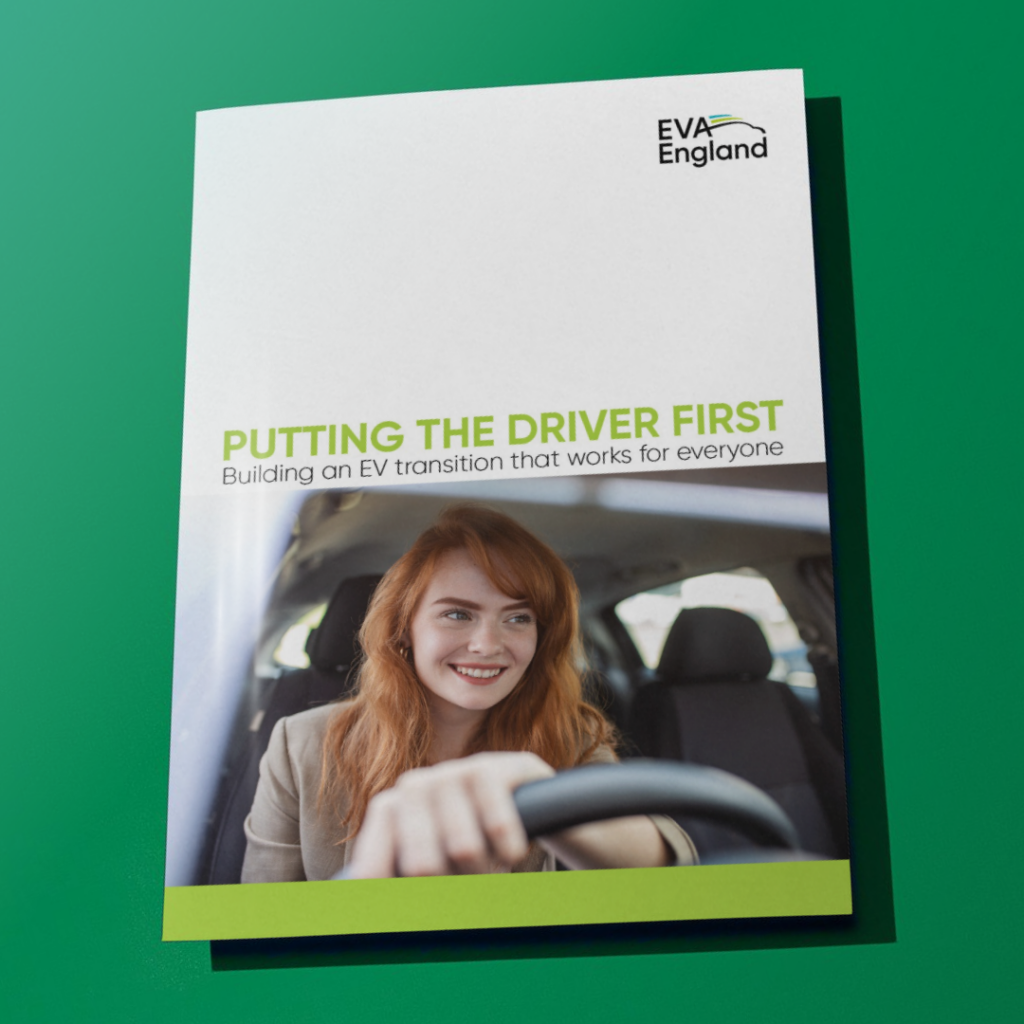
Putting the Driver First sets out our recommendations to Government on building an EV transition that works for everyone, focusing on three core pillars:
We are calling for a practical, driver-first plan that supports households currently blocked from switching, including lower and middle-income families, renters, leaseholders, disabled drivers and those without driveways.
“We welcome the focus on accessible and affordable charging in EVA England’s Putting the Driver First white paper. The public network continues to grow and has now topped 120,000 EV chargers across en-route, destination and on-street locations, supporting nearly four million sessions every month. We now need to prepare for the next five million EV drivers, an increasing number of whom will be entirely reliant on public charging, not having the cost advantages of home charging.
“Supporting CPOs to reduce cost burdens and leveraging innovative near-home charging solutions will be crucial steps toward lowering prices for drivers and maintaining momentum in the UK’s transition to sustainable transport.”
Ian Plummer, Chief Customer Officer at Autotrader, the UK’s largest automotive marketplace, added:
“We must make sure the electric transition is accessible and equitable. Right now, there’s a real risk that certain groups of people are going to be left behind as we transition to a cleaner, and often cheaper, version of car ownership. It’s not yet clear how the Government will achieve this and we believe we need answers, a plan, a strategy, now, not later.”
Craig Marsden, CEO of EVCI, said:
“Drivers are right to demand cheaper, fairer public charging, but price only means something if the right regulatory regime is in place behind it. This includes having the right standards in place and knowing that the energy is being properly measured and going through to the chargepoint. Independent verification across several hundred charging sessions, shows a significant share of public chargers fall outside the accuracy tolerance for this that drivers are entitled to expect. You cannot have a fair transition built on measurements you cannot trust. Affordability and accuracy have to be solved together.”
By supporting EVA England, you can help ensure the transition is not just fast, but fair – building driver confidence and making sure no household is left behind simply because of where they live or how much they earn.
If you would like to support our work and help ensure driver voices shape the future of the EV transition, you can get involved by becoming a member, a supporting partner or donating directly to EVA England.
Every member and contribution helps us make sure EV drivers’ voices are heard in Parliament, and future policies reflect real-world experiences.