Our annual survey on electric vehicles, now exploring the views of all drivers on EVs, charging, and the road ahead.

EVA England’s annual survey offers invaluable insights into EV drivers’ experiences, charging habits, and consumer confidence.

First launched in 2021, it started as a way to give electric vehicle owners a voice in the Public Charging Regulations.

In 2025, we expanded it to include all drivers – whether they drive electric, hybrid, petrol, or diesel – because understanding the views of every motorist is key to accelerating the switch to electric. This year’s survey was open to drivers across the UK, not just England, and delivered in partnership with EVA Cymru and EVANI, with the support of Octopus Electroverse.

Each year, thousands of drivers take part, helping us build a rich picture of how charging is working, where it’s falling short, and what’s needed to make the transition easier. We then share our findings with government, industry, and the public to drive meaningful change.

Our 2025 survey report is now out.

We found a widening “charging divide” between UK drivers who can easily charge at home and those who cannot.

While nearly 9 in 10 (87%) of drivers with driveways found their EV “much cheaper” to run compared to a petrol or diesel car, only half (50%) of drivers without a driveway agreed. The gap risks leaving millions of households behind in the country’s transition to electric vehicles.

Read more

Our 2025 underscored another resounding ‘Yes’ from EV drivers:

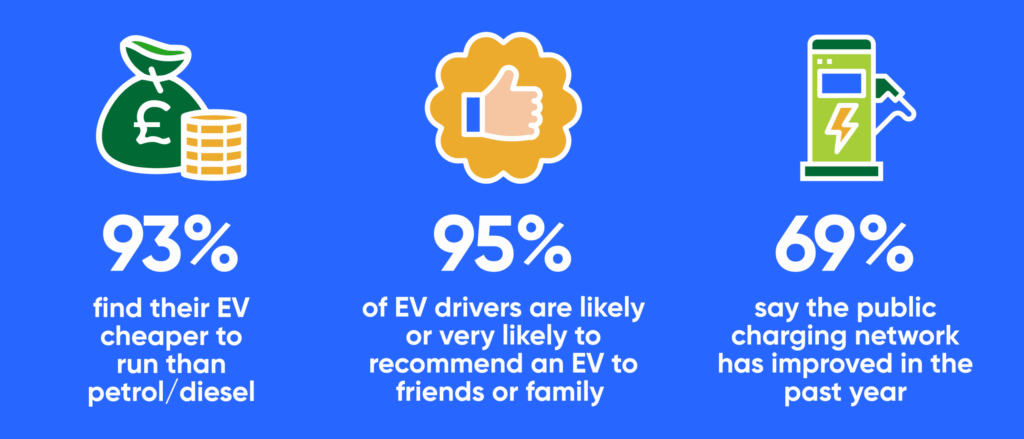
The results highlight growing confidence among EV drivers, with 95% responding saying they would recommend these cars to friends and family, and more than 9 in 10 saying their EV is cheaper to run than their previous petrol or diesel cars.

Over two-thirds (69%) highlighted real improvements in public charging infrastructure over the past year. Indeed, 66% of petrol and diesel drivers responding say they are considering switching to electric; and 62% of those driving hybrid vehicles say that their next vehicle purchase will be fully electric.

With just under 1,700 respondents, EVA England’s 2025 survey revealed that EVs are increasingly being seen as an established, trusted technology, with strong driver satisfaction.

However, the survey also highlights that real challenges to transitioning to an EV persist. These include psychological and educational barriers for some non-EV drivers, but we are also seeing continued inequities arising around access to and affordability of these cars.

Our survey, now allowing EVA England invaluable year-on-year comparisons, has been an opportunity to reflect on where the sector is headed, which Government policies are having a tangible impact on drivers, and which are being most called for next by drivers themselves.

Read the full report

Our 2025 findings:

Key Findings

  • 90% have access to off-street parking; 81% own a home chargepoint.
  • Home charging remains the biggest driver of satisfaction and cost efficiency:
    • 87% of drivers without a driveway are finding their EV much cheaper to run than petrol and diesel
    • But only 50% of drivers without driveways agree.
  • Urban EV drivers continue to face greater challenges, with 25% lacking home charging access versus 8% suburban and 5% rural.
  • 32% have been driving an EV for two years or less; 25% for over five years.

EV Purchasing Experience

The upfront cost of EVs remains a significant concern: 50% of EV drivers find them more expensive to buy than petrol or diesel vehicles, with only 29% describing prices as “about the same.”

While drivers overwhelmingly view EVs as cheaper to run, many note that these savings do not yet offset the higher initial outlay.

  • Ownership patterns

Nearly half (49%) of EV drivers bought their car outright, but leasing and salary sacrifice schemes are becoming increasingly influential.

Around 19% used Personal Contract Purchase (PCP) and 11% obtained their vehicle through an employer, most commonly through tax-efficient salary sacrifice.

As one respondent said: “Salary sacrifice made the difference – it made it affordable for us to switch.”

  • Second-hand market

By contrast, most petrol and diesel drivers (74%) bought their vehicles second-hand.

This shows that the used EV market remains underdeveloped and less attractive to many buyers.

  • Experiences of buying and receiving an EV are mixed.

While 61% rated their handover as good or excellent, a quarter found it only fair or poor.

Many cited dealership staff’s lack of technical knowledge:

“The salesperson had no knowledge of EV chargers”

“Owned multiple EVs over 8yrs. Only once did I have a really good handover”

“Great service from the supplier with one hour of set-up and driving tuition.”

“In contrast to what we hear about some dealerships, we found our local MG dealership […] to be very well-informed and patient in talking us through the options.”

EV Charging Experience

  • Home Charging

Home charging remains one of the foundations of the positive EV ownership experience.

  • 9 in 10 EV drivers have access to off-street parking
  • 81% charge at home, allowing them to take advantage of cheaper electricity tariffs
  • 93% of EV drivers are finding day-to-day costs cheaper than petrol or diesel. This is heavily skewed towards drivers with driveways, however.

Anecdotal evidence from comments repeatedly pointed to frustrations over high public charging costs that are making EVs an unattractive prospect for many drivers without home charging. For example those living in more concentrated urban environments.


  • Public Charging

69% say public charging has improved in the past year.

82% find chargers “usually or always” in good working order.

Top requests for improvement:

  • More chargers and better availability (especially in rural and motorway areas).
  • Lower prices and reduced VAT on public charging.
  • Simpler payment systems (universal contactless preferred)
  • Faster chargers at key routes.
  • Better lighting, signage, and reliability.


Overall, drivers continue to call for more chargers, fairer prices, and simpler access. Many cited frustrations over high charging costs and more specific issues, such as fragmented apps.

Petrol, Diesel and Hybrid drivers

  • Petrol & Diesel

Encouragingly, two-thirds (66%) have considered getting an EV, but 39% say they are unlikely to choose one next time.

From our qualitative analysis, the top five perceived barriers stopping more petrol and diesel from switching to a full battery EV were:

  • Concerns over range, e.g mileage of the car, battery – 48%
  • Upfront cost – 46%
  • Private charging infrastructure, e.g access to home charging – 38%
  • Perception that charging infrastructure is difficult to use – 29%
  • Availability of public charging points – 25%

We also found a correlation between access to off-street parking and confidence in switching:

60% of drivers without off-street parking say they are unlikely to switch, compared with 43% of those who have access to a driveway.


  • Hybrid Drivers

Hybrid drivers, representing 8% of our respondents, showed stronger readiness to go fully electric:

  • 62% say driving a hybrid has made them more likely to choose a full EV next time
  • 56% drive in electric mode for most journeys.
  • 72% have considered getting an EV in the last couple of years.

For many, hybrids are a transitional step.

Common reasons cited for choosing hybrid over full EV:

  • Range and long-distance concerns – 14%
  • Charging infrastructure availability – 11%
  • Home charging access issues – 8%
  • Current vehicle ownership – 8%

Persisting barriers to EV

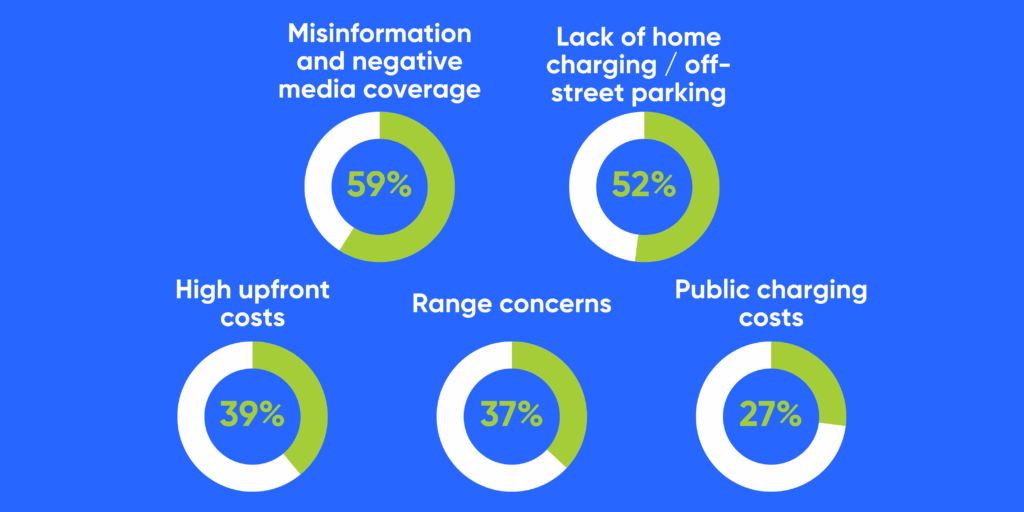
Our analysis of drivers’ comments revealed the following themes and the frequency with which they were mentioned as prevailing barriers preventing more drivers from considering a switch to electric:

Overall, the responses show that while technology and infrastructure are improving, perception, misinformation, and inequality in access are now the leading obstacles to universal EV confidence.


We will use our survey results as the foundation for a deeper dive with our members to develop a new EVA England driver’s strategy to be launched in early 2026. This Strategy will aim to set out an updated set of recommendations for how to achieve this.

If we can make sure the consumer is at the heart of the EV transition, we can secure its success.


Read the full report

Interested in viewing previous iterations of our annual survey report?

You can find them here:

A fair transition must work for everyone.

At EVA England, we’re working to make sure every driver, no matter where they live, can access affordable and reliable charging.

If you would like to support our work and help strengthen our advocacy for fair and accessible charging, you can get involved by becoming a member, a supporting partner or donating directly to EVA England.

Get involved

Share via
Copy link
Powered by Social Snap