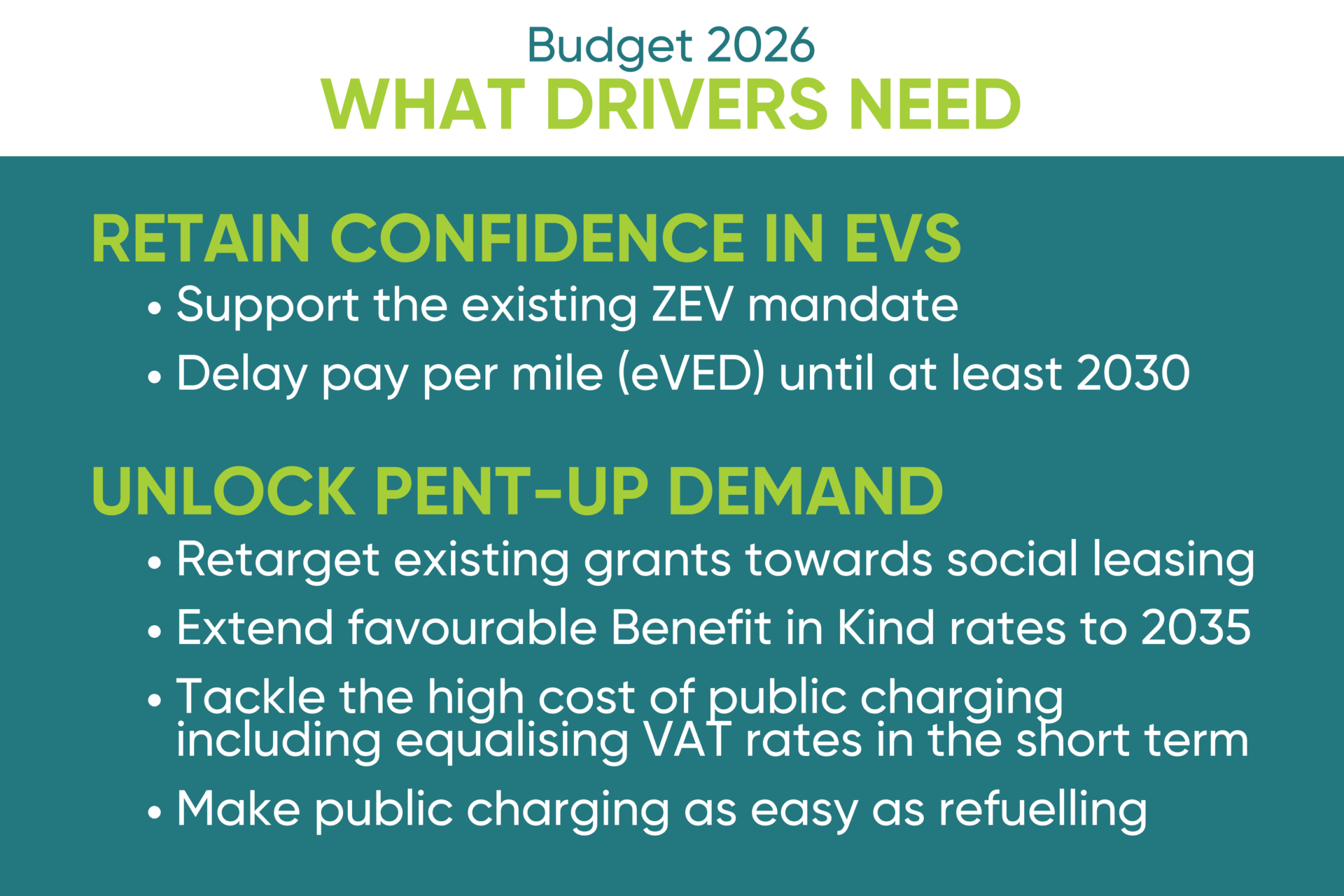
With Budget 2026 arriving early, hot on the heels of the close of the ZEV mandate review, and further spending decisions expected before Christmas, what is EVA England asking for on behalf of EV drivers from these upcoming fiscal events?
Measures that respond to the challenges holding more drivers back from switching to electric.
This does not mean just adding money to the existing grant and funding pots. It means looking at where and how those pots are targeted so they unlock real demand; and it means looking at the underlying taxation and regulatory regimes to make sure they support drivers into EVs, rather than penalising them or asking them to pay for the costs of the EV transition.
What are these measures?
– Retaining consumer confidence in EVs
- Support the existing ZEV mandate: fiddling with it will only spread more confusion, doubt and misinformation about EVs, and undermine the growth of a sector that is starting to work for consumers.
- Delay the pay per mile tax (eVED) until at least 2030, when the barriers holding consumers back from switching to electric have been properly addressed; and make it work for the driver from day one, with payments in arrears, a proper refund regime and protections from third-party costs. EV drivers must not be left out of pocket or penalised by a scheme that does not work for them – yet three quarters of EV drivers fear that will be the case.
– Unlocking pent-up demand for EVs
- Retarget existing grants to those who want to buy electric but cannot afford to do so. Half of drivers are still struggling with the upfront cost of EVs, and less than a third of EV drivers are from households on middle and lower incomes. A subsidised social leasing scheme, targeted at these households, has the potential to unlock a sale of nearly a million more EVs by 2035.
- Extend favourable Benefit in Kind rates to 2035, supporting an increasing number of drivers into EVs through the salary sacrifice and leasing schemes that are making these cars more attractive and affordable for many.
- Tackle the high cost of public charging, which remains one of the biggest barriers to a successful EV transition. Only 32% of EV drivers relying on the public charging network now say they are saving money running their car, down from 50% last year.
- Publish the outcomes of the Cost of Charging Review, and make sure they deliver structural changes that significantly reduce the price we as drivers pay.In the meantime, equalise VAT between domestic and public charging in return for a commitment from Chargepoint Operators (CPOs) to pass the resulting savings onto their customers
- Include charging credits in any social leasing scheme targeted at lower and middle income households.
- Make our charging experience as seamless and easy as refuelling at a petrol pump: less than half of EV drivers now believe the public charging network is fit for their purposes.
- Appoint an independent, statutory Public Chargepoint Regulator, including a consumer complaints service and Ombudsman, to protect and advise drivers, and so support development of a chargepoint network that is accessible, easy to use, and fit for purpose for the future.
- Couple that with a review of the Automated and Electric Vehicles (AEV) Act 2018 and Public Charge Point Regulations 2023 to ensure they work for the drivers.
Figures are from EVA England’s Steer the Conversation 2026 and eVED survey reports, and our social leasing report with T&E and Cambridge Econometrics.
Help keep drivers at the centre of policy
With major decisions ahead on road pricing and charging infrastructure, EVA England is working to make sure drivers remain at the centre of policy discussions.
By supporting our work, you can help ensure that these policies are shaped by real driver experience, for a faster, fairer transition to electric that works in practice.
If you would like to support our work and help ensure driver voices shape the future of the EV transition, you can get involved by becoming a member, becoming a supporting partner or donating directly to EVA England. Every member and every contribution helps us make sure EV drivers’ voices are heard in Parliament.