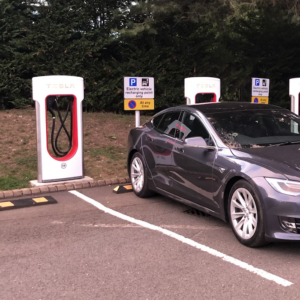
EV Chargers are categorised into 4 main types:

Standard, Standard Plus, Rapid and Ultra-Rapid.

These are differentiated by how quickly they can charge up a car based on the charger’s maximum power output and how much power the car’s battery can take.

Rapid charging times are often quoted for a charge to 80% (not 100%) because charging speeds slow significantly after 80%.

Charging to only 80% will reduce charging time and help protect your battery’s lifespan. Some manufacturers recommend charging to 80% unless you need to travel a longer distance.
Standard

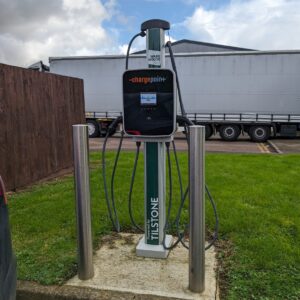
Standard chargers use AC and have the lowest electricity power output, ranging from 3kW to 7.9kW.

Standard chargers are usually used when charging at home where vehicles can be left overnight to slowly charge. You’ll also find them in places where your vehicle will be idle for a while, such as at the residential areas or office and public car parks.

Charging times will vary depending on the charging unit and the particular EV being charged, but for a car with a 60-80kWh better it would take from 6 to 12 hours to charge from 20 to 80%.

To use a Standard charger, you will need to provide your own cable.


Standard Plus

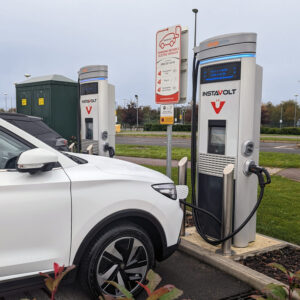
The bulk of the public charging network is made up of Standard Plus chargers, most of which are AC chargers. They have a power output ranging between 8kW and 49kW – a big difference from their Standard charging counterparts.

Standard Plus chargers tend to be found wherever you’re likely to park for an hour or more such as supermarkets, department stores, leisure centres or public car parks. While a higher voltage is tempting, most EVs are limited to 11kW AC charging, so make sure to check your vehicle maximum charging rate.

To use a Standard Plus charger, you will typically need to provide your own cable.

Rapid

They are the most common type of rapid EV chargers in the UK and can be found at most motorway service stations.

Rapid chargers are the quickest way to charge your battery, with a power output ranging from 50kW to 149kW.

Rapid charging can only be used on vehicles with rapid charging capabilities and all rapid chargers will have cables tethered to the individual unit. You’ll still be able to use a 50kW charger even if your model can’t accept such a high rate, as the power will be restricted to whatever your car can handle.

Your car knows what it can handle and will automatically restrict the power.

Depending on your model and starting charge, rapid chargers can recharge your battery from 20 to 80% in 30 to 75 minutes.

Rapid DC chargers use CCS connectors (the standard connector for most EVs today) or CHAdeMO connectors (used by some EVs such as the Nissan LEAF).


Ultra-Rapid

Ultra-rapid DC chargers provide power at 150kW or more.

Ultra-rapid chargers are the new frontier of EV charging as they are able to keep charging times down even as battery sizes increase in newer electric models. Most EVs can charge from 20 to 80% in around 20 to 30 minutes when using ultra-rapid chargers, depending on the vehicle’s battery size and maximum charging rate.

Gridserve’s Electric Forecourt at Gatwick Airport has 22 High Power chargers capable of charging at 350kW. Although most electric cars aren’t currently equipped to take a 350kW charge, this is an excellent example of how the automotive and energy industries are preparing for an electric future.

This truly is an exciting time to be an EV driver!


Tesla Supercharger Network

The Tesla Supercharger network is a network of over 1,100 a DC ultra-rapid chargers, and you’ll have probably seen their distinct large red and white chargers at some point.

The majority of Tesla superchargers have a speed of either 120 kW or 150 kW. However only a handful of them are open to all EVs, for the majorty of them you have to be a Tesla driver to use them.

Their newer V4 Superchargers can charge up to 250kW and these are now open to all EVs with a CCS charging port. (You can watch James at the unveiling of the first UK V4 Tesla Superchager Station in Tottenham here)

AC vs DC? kW and kWh? What does it all mean?Find out here!CCS or Type 2? What are all the different types of connectors?From finding where to lease a car to finding a public charger, and more!Here are all the online resources you need!
Share via
Copy link
Powered by Social Snap