
26 March 2026
Government plans for a new pay-per-mile charge risk holding back the next wave of EV adoption, according to a major new driver survey published today.
EVA England’s research, released as our Chief Executive, Vicky Edmonds, appears before the Transport Select Committee yesterday, shows lower-income drivers are most concerned about the scheme’s design, raising fresh warnings that the transition could fall short without action on affordability and charging.
Across the Select Committee session, Vicky Edmonds and other witnesses warned that demand is not keeping pace with supply, with affordability, charging access and confidence now the critical constraints on mass adoption.
The survey highlights a growing divide between early adopters and the wider public. Lower-income drivers – who are critical to mass adoption – are significantly more concerned about how the Government’s proposed pay-per-mile scheme (eVED) will work in practice, particularly the requirement to estimate and pay for mileage upfront.
Among households earning under £26,000, 76% are concerned about upfront payments, compared to 56% of the highest earners, with real concerns that they will be left out of pocket by the scheme.
EVA England warns that without changes, policies like eVED risk reinforcing existing barriers rather than helping more drivers make the switch – particularly at a point when confidence among mainstream households is still fragile.
She said:
“From a driver’s perspective, we are creating a two-tier transition. We’ve got around 25% of new car sales electric, but only 5.5% of the overall car parc. Those getting into EVs love them. But they are disproportionately higher income and more likely to have driveways.
“Unless we make this work for a wider range of households, the transition will not reach the mass market.”
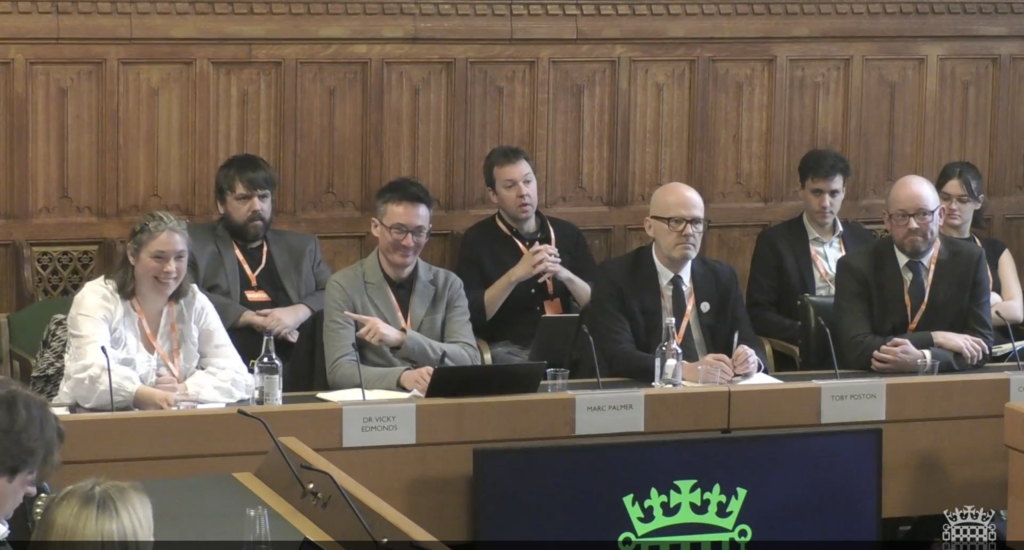
Vicky Edmonds, alongside Marc Palmer (Autotrader), Toby Poston (BVRLA) and Colin Walker (ECIU) at the Transport Select Committee – Supercharging the EV transition session
Vicky Edmonds told MPs that cost remains the defining barrier:
“For low and middle income households, cost is absolutely essential. There are many who want to switch but simply cannot afford to today. And eVED, which in its proposed form carries significant risk that it will leave drivers out of pocket, only adds to that cost uncertainty.”
While EV drivers consistently report high satisfaction once they switch, many households remain locked out. Around half of drivers without access to home charging report higher running costs than petrol or diesel, driven by the higher price of public charging. Drivers without driveways can sometimes pay up to ten times more for charging than those who can charge at home.
Alongside the survey, EVA England has published information on new analysis with Transport & Environment showing how Government support could be better targeted to unlock access to EVs for millions more households.
The report finds that current incentives are largely focused on new vehicles and higher-income drivers, while most households – who typically buy used cars – are not yet being reached.
It sets out practical solutions, including subsidised social leasing schemes and simple “all-in one” packages combining vehicle, insurance and charging, which could bring EVs within reach of lower and middle income households.
Eloise Sacares, Vehicles Policy Senior Researcher at Transport & Environment, said:
“Social leasing is the perfect next step for the UK’s EV transition. With the introduction of eVED approaching, the government must put in place targeted incentives for those who currently drive ICE cars to transition to BEVs.
“While the Electric Car Grant reduces costs for consumers who buy their cars upfront, there is currently no support for those who lease their vehicles. With the cheapest EV lease at £141 a month, those on low incomes are priced out and unable to benefit from lower running costs. By bringing leasing costs down to as low as £77 a month, we can ensure that EVs are accessible and reduce bills for all.”
Vicky Edmonds added:
“Right now, too many drivers are looking at the transition from the outside in. If we want EV adoption to scale, we need to make it affordable, simple and predictable – especially for those without driveways or access to upfront capital.
That means getting the basics right: fair taxation, lower public charging costs, and targeted support that reaches the majority of households. EVA England is calling on Government to delay the introduction of eVED until at least 2030, redesign the scheme so drivers pay based on actual mileage rather than estimates, and ensure it is introduced alongside meaningful action on charging costs and affordability.”
By supporting EVA England, you can help ensure future road pricing and charging policies are shaped by real experience and support a faster, better transition to electric that works in practice.
If you would like to support our work and help ensure driver voices shape the future of the EV transition, you can get involved by becoming a member, a supporting partner or donating directly to EVA England.
Every member and contribution helps us make sure EV drivers’ voices are heard in Parliament, and future policies reflect real-world experiences.