12 January 2026
Over 9 in 10 EV drivers we survey have a driveway, and 87% of these are finding it cheaper to run their EV than they did their previous petrol or diesel car. However, that number drops to 50% for EV owners without a driveway, who are reliant on the public charging network for their everyday charging needs.
The domestic price cap for charging at home is currently sitting around 26p pkWhr, and the use of smart meters means many drivers can pay as little as 7p pkWhr for their home charging, with EV drivers saving on average around £1,000 a year in running costs. Conversely, the average costs of charging on a slow or fast residential public charger are around 52p pkWhr – and 76p pkWhr for a rapid/ultra-rapid charger.
That is a very real and very significant price difference, and the current high costs of public charging have been acknowledged across the EV sector and by Government. Chargepoint operators (CPOs) are starting to introduce membership options to try to give drivers cheaper rates of charging; and the Government has launched a Public Charging Review to look at policy and regulatory options for driving the costs of public charging down. But whilst these are welcome movements, regulatory change takes time, and even with them, CPOs are unlikely to be able to get their charging rates down as low as domestic rates.
Whilst they may not work for everyone, they can work for many and should be seriously considered by all those responsible for rolling out public charging infrastructure at local level.
Yet until a few months ago, this wasn’t happening. Many local authorities were not willing to consider cross-pavement technologies as part of the charging infrastructure mix in their areas; and drivers applying for the technology were left waiting for up to 15 months for a decision, and having to pay up to £3,000 in planning and installation costs.
The Planning and Infrastructure Bill, a vast piece of legislation designed to make the planning process for major infrastructure projects, including renewable energy projects, was a clear opportunity to raise awareness of these issues within Parliament, and to seek concrete reassurances and commitments from Government to address them. We are immensely grateful to Helen Maguire MP and Baroness Pidgeon, who intervened in the Bill debates to ask for changes to planning law to make it easier and cheaper to install cross-pavement technologies where they do work.
EVA England did not achieve these changes by ourselves: we were supported by our partners at Tendo Consulting, the REA, New Automotive, and our new brand supporter Kerbo Charge, and we are immensely grateful to them all for their continuing support and efforts.
Kerbo Charge install a ‘through-pavement’ EV charging channel outside residents’ homes.
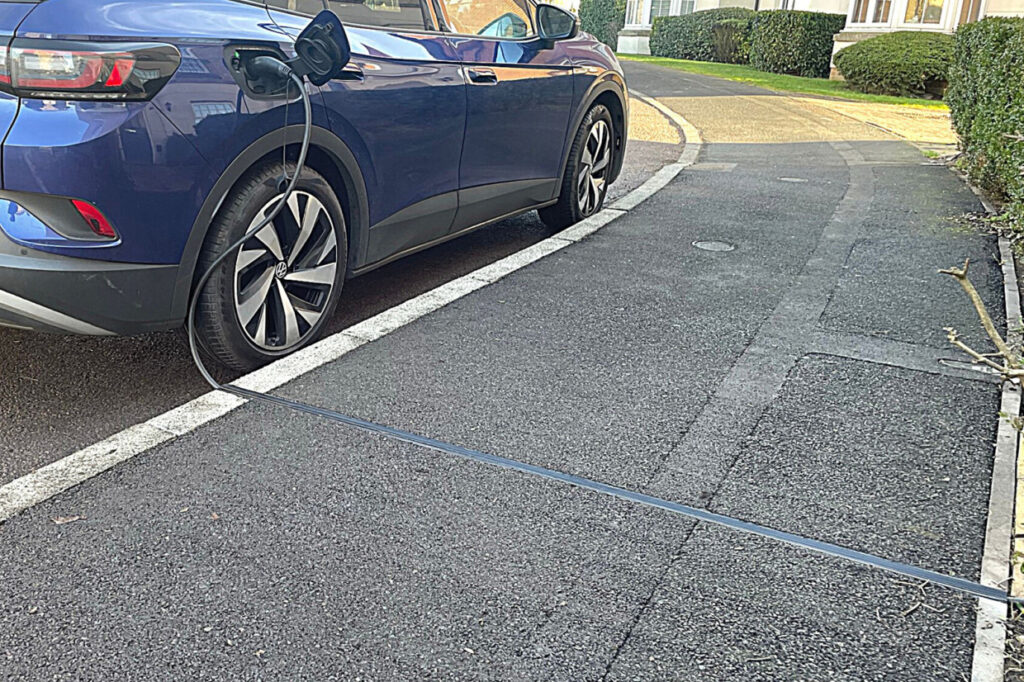
When drivers want to charge, they lift the lid, insert their cable, and the specially designed lid closes behind just like a zip. The cable is then safely enclosed and won’t trip anyone over, and the resident can charge from their home supply, taking advantage of off-peak tariffs.
Kerbo Charge is a market leader for cross-pavement channels, having installed over 1,000 units across 33 local authorities in the UK. However, over 150 councils are yet to make cross-pavement solutions available to their residents.
The most important topics for councils are maintenance and liability – local authorities rightly need to understand who’s responsible if (however unlikely) an accident were to occur, and who’s responsible for maintaining the product, given how stretched their highways teams are.
Most car insurance providers now include cable trip cover as standard – providing peace of mind to local authorities – and providers like Kerbo Charge offer a managed service option whereby, for a small monthly fee to the resident, they take on all financial responsibility for any repairs to the product or surrounding installation over the lifetime of the product.
To date, Kerbo Charge residents have reported a great sense of ‘freedom’ that they’re able to make the move to EV with confidence, summed up well by this review on Trustpilot:
Peter Wright, Kerb Charge customer from Bedfordshire says:
“So simple but so brilliant! Being able to now safely charge my company car from home instead of using the public charger network is saving me circa £250 a month. Ben kept me informed along the way, and the two guys who came to install it were very helpful and professional!
“One happy, better-off customer – well done, Kerbo Charge”
And local authorities have also consistently fed back that they like the ease of installation and total focus on after-sales support.
Denise Gaines, Executive Member for Highways, West Berkshire Council:
“This transforms the electric vehicle charging experience, ensuring safety and convenience. No more trip hazards, just a seamless blend of sustainability and practicality right at your doorstep.”
This experience is echoed across a number of case studies from across the UK for local authorities to draw upon, and Kerbo Charge is happy to put any council in touch with other officers to get first-hand objective feedback.
For drivers without a driveway, these are real and positive steps. Cross-pavement charging will not be right for everyone, but where it does work, it can mean access to cheaper charging, lower running costs, and one less barrier to switching to an EV.
At EVA England, we want to make sure drivers’ experiences stay at the heart of these decisions. If you do not have a driveway and are driving or considering an EV, or if you would like to install a cross-pavement solution, please share your experience through our short survey. Your feedback will help shape our response and make sure future changes genuinely work for drivers.
The charging divide remains one of the biggest barriers to wider EV adoption. Progress on cross-pavement charging shows that this gap is finally being taken seriously at the highest levels
EVA England campaigns for charging that works for everyone, not just those with driveways, so that no driver is left behind in the transition to electric.
If you would like to support our work and help us tackle cost and access inequalities,, you can get involved by becoming a member, a supporting partner or donating directly to EVA England.
Every member and contribution helps us make sure EV drivers’ voices are heard in Parliament and that the UK’s charging infrastructure works for everyone.